
Therapists are often taught to be cautious. We are told to know our scope, practice within our competence, document carefully, and avoid making claims we cannot support. All of that matters.
But caution can become fear very quickly.
That is especially true when emotional support animal letters come up. A therapist may know their client well, and understand exactly how the animal supports the client’s functioning, reduces psychiatric symptoms, interrupts isolation, or helps the client remain connected to life. Still, the therapist encounters broad professional guidance about competence, legal knowledge, and human and animal interactions, and suddenly begins questioning whether writing a letter requires an entirely separate specialization.
I do not believe it does.
Writing an emotional support animal letter is not animal assisted therapy. It is not animal training. It is not an evaluation of whether an animal is safe in every possible environment. It is not a certification of the animal’s temperament, behavior, or legal status.
It is clinical documentation.
The therapist is assessing the client, not certifying the animal.
The therapist is documenting that the client potentially has a disability and that the animal’s presence provides emotional support that alleviates one or more identified symptoms or effects of that disability. In the housing context, that information may support the client’s request for a reasonable accommodation.
That is not outside the ordinary work of psychotherapy. It is an extension of the assessment, documentation, advocacy, care coordination, and disability related support that therapists already provide.
What the law actually distinguishes
One of the first things therapists need to understand is that an emotional support animal is not the same as a service animal.
Under the Americans with Disabilities Act, a service animal is generally a dog that has been individually trained to perform work or tasks directly related to a person’s disability. A psychiatric service dog may be trained to interrupt self injurious behavior, remind someone to take medication, recognize an emerging psychiatric episode, guide a disoriented person to safety, or take another specific action in response to the person’s disability.
An emotional support animal is different. Its presence provides comfort, companionship, emotional regulation, or another therapeutic benefit, but the animal has not necessarily been individually trained to perform a specific disability related task, and you are not claiming that is the case. For that reason, emotional support animals do not qualify as service animals under the ADA and do not receive the same broad right of access to restaurants, stores, workplaces, or other public accommodations.
That distinction matters because an ESA letter does NOT:
Transform an animal into a service animal.
Grant public access rights.
Certify that the animal has completed specialized training.
Entitle the client to bring the animal everywhere.
Establish that the animal is exempt from ordinary behavioral expectations.
In California, the required notice is especially clear that an “emotional support dog does not possess the special training required of a guide, signal, or service dog and is not entitled to the legal rights and privileges afforded to those animals.”
The primary federal protection relevant to ESAs is generally found in housing law, not the ADA’s public access provisions.
What housing law says
Under the Fair Housing Act framework, HUD uses the broader category of an “assistance animal.” An assistance animal may perform tasks or provide assistance, but it may also provide emotional support that alleviates one or more identified effects of a person’s disability. It is not considered a pet for purposes of the reasonable accommodation analysis.
A person with a disability may ask a housing provider to make a reasonable accommodation to a rule, such as a no pets policy, pet restriction, or pet fee. When the disability or the disability related need for the animal is not apparent, the housing provider may request reliable disability related information supporting the request.
This is where a therapist’s letter may become relevant.
The letter can document two central clinical facts:
First, the person has a disability.
Second, there is a relationship between that disability and the assistance provided by the animal.
The animal must alleviate at least one identified symptom, effect, or functional consequence of the disability. The law does not require the animal to cure the condition. It does not require the client to become symptom free. It does not require the animal to be the client’s only source of support.
The animal must provide disability related assistance or emotional support that is meaningfully connected to the client’s ability to function, remain regulated, use and enjoy their home, or manage the effects of the disability.
That can look different across clients.
For a client with severe depression, the animal may create enough external responsibility to help the client get out of bed, eat, walk outside, or maintain a daily routine.
For an autistic client, the animal’s predictable presence may reduce overwhelm, provide sensory and emotional regulation, interrupt isolation, or help the person recover after significant dysregulation.
For a client with PTSD, the animal may reduce hyperarousal, provide grounding during trauma activation, make it possible to sleep, or lessen the intensity of being alone during predictable triggers.
For a client experiencing suicidal ideation, attachment to an animal may function as a protective factor. The client may remain alive because they cannot tolerate the thought of leaving the animal unattended or uncared for. That does not mean the animal replaces a safety plan, crisis intervention, or appropriate clinical care. It means the relationship may be one real and clinically significant reason the client remains connected to life.
Those are not abstract benefits, they are clinically observable effects connected to symptoms, functioning, safety, and quality of life.
What an ESA letter does
A well written ESA letter provides reliable clinical documentation supporting a reasonable accommodation request.
Depending on the jurisdiction and the purpose of the letter, it may confirm that:
The clinician has an established professional relationship with the client.
The clinician is appropriately credentialed and authorized to provide services in the relevant jurisdiction.
The client has a physical or mental impairment that substantially limits one or more major life activities, without necessarily disclosing every diagnostic detail.
The animal provides emotional support that alleviates one or more identified effects of the client’s disability.
The accommodation is clinically related to the client’s disability related needs.
The letter should be specific enough to establish the connection between the disability and the need for the animal, while still protecting the client’s privacy.
A letter does not need to disclose the client’s entire trauma history, full diagnostic record, therapy notes, medication history, or the details of every symptom. The housing provider generally needs reliable disability related information, not unlimited access to the client’s clinical life.
What an ESA letter does not establish
A responsible ESA letter should not claim more than the clinician actually evaluated.
It does not certify the animal as safe, obedient, trained, or suitable for every setting.
It does not certify that the animal will never cause property damage.
It does not determine whether the animal poses a direct threat to another person.
It does not guarantee that a housing provider must approve every request under every circumstance.
It does not eliminate the housing provider’s ability to consider whether a specific animal poses a direct threat, would cause significant property damage, or whether another legally recognized exception applies. HUD identifies limits involving undue financial or administrative burden, fundamental alteration, direct threat, and significant physical damage that cannot be sufficiently reduced through another accommodation.
It also does not turn the animal into a service animal or create public access rights under the ADA.
This distinction protects the client, the clinician, service animal handlers, housing providers, and the integrity of the accommodation process.
The phrase that makes therapists anxious
Professional guidance may state that “a counselor should have knowledge of applicable federal, state, and local laws, along with appropriate knowledge, skills, and attitudes concerning therapeutic human and animal interactions.”
That wording can sound much more specialized than the underlying clinical task actually is.
Professional associations tend to write guidance in a broad and protective way. They establish a standard, then place responsibility on the clinician to decide whether their education, experience, consultation, supervision, and preparation are sufficient to meet it.
This does not automatically mean that a therapist must complete a formal certification in animal assisted therapy before writing an ESA letter.
It means the clinician should not act casually, make unsupported promises, misunderstand the applicable law, or represent themselves as having expertise they do not possess. Competence is not always synonymous with formal certification.
Clinical competence can be developed through education, focused continuing education, consultation, supervision, review of the relevant laws and agency guidance, use of a consistent evaluation process, careful documentation, and recognition of the limits of the clinician’s role.
The question is not, “Do I possess a separate credential in human and animal interactions?”
The better questions are:
Do I understand the difference between an ESA, an assistance animal, a therapy animal, and a service animal?
Do I understand which law applies to the request?
Do I understand what the animal must alleviate?
Have I clinically evaluated the client’s disability related need?
Do I have enough information to support the statements in the letter?
Am I staying within my role by evaluating the client rather than certifying the animal?
Am I documenting my reasoning?
Have I sought consultation or supervision when I am uncertain?
Those questions reflect actual competence.
What knowledge of human and animal interactions can reasonably mean
A therapist writing ESA letters should understand that relationships with animals can affect emotional regulation, attachment, routine, social connection, behavioral activation, grief, safety, and daily functioning.
That does not require the therapist to become an animal behaviorist, it requires enough knowledge to evaluate the clinical role the animal plays in this particular client’s life.
A competent therapist should be able to explore questions such as:
What symptoms become more manageable when the animal is present?
What happens to the client’s functioning when separated from the animal?
Does caring for the animal support routines such as waking, eating, movement, hygiene, sleep, or leaving the home?
Does the animal interrupt isolation?
Does physical contact or proximity help the client regulate?
Does the animal reduce the intensity or duration of panic, dissociation, depressive collapse, or trauma activation?
Does the relationship provide a meaningful protective factor during suicidal crises?
Is the claimed benefit based on an established pattern, or is it speculative?
Is there a disability related need, rather than only a general preference to keep a pet?
Has the therapist observed or discussed this relationship over time?
This is human and animal interaction knowledge applied clinically. The therapist is understanding the psychological and functional relationship between the client and the animal.
The therapist is not evaluating veterinary health, breed characteristics, obedience, aggression risk, or animal training unless separately qualified to do so.
Why this is within a therapist’s scope
Clinical social work includes psychosocial assessment, counseling, psychotherapy, information and referral, advocacy, interpretation of psychosocial circumstances, and helping individuals modify internal and external conditions that affect behavior, emotions, thinking, and functioning. California’s statutory description of clinical social work expressly includes these broad clinical and social functions.
An ESA evaluation sits directly inside that work when it is done correctly.
The therapist assesses the client’s symptoms and impairment.
The therapist evaluates how the animal affects those symptoms.
The therapist determines whether a disability related connection is clinically supportable.
The therapist documents the conclusion.
The therapist helps the client request removal of a housing barrier.
That is disability advocacy grounded in clinical assessment.
Therapists regularly write documentation supporting medical leave, workplace accommodations, academic accommodations, disability services, treatment participation, housing stability, and continuity of care. An ESA letter is not categorically different simply because the accommodation involves an animal.
The therapist is still documenting the relationship between a disability, functional impairment, and a requested accommodation.
Supporting clients is part of the work
Therapists have a responsibility to protect boundaries and avoid unsupported documentation. We also have a responsibility not to use professional anxiety as a reason to abandon clients when they need legitimate advocacy.
Housing instability can intensify psychiatric symptoms. The threat of losing an animal can destabilize a person whose daily routine, emotional regulation, or sense of safety depends heavily on that relationship. Pet restrictions and fees can create real barriers for disabled clients, especially those with limited income.
A therapist who understands the client’s disability and the role the animal plays may be uniquely positioned to document that need.
We should not write letters merely because a client wants to avoid a pet deposit.
We should not use a diagnosis alone as automatic proof that an ESA is necessary.
We should not guarantee outcomes.
We should not produce letters after a brief transactional encounter that gives us no meaningful basis for the clinical conclusion.
But when the need is legitimate and clinically supported, refusing to help solely because the documentation feels intimidating is not automatically the more ethical choice.
Ethics includes competence, honesty, and appropriate limits. It also includes advocacy, access, continuity, and the removal of unnecessary barriers.
California requirements
California imposes specific requirements when a health care practitioner provides documentation concerning an individual’s need for an emotional support dog.
The practitioner must hold a valid and active professional license, include the effective date, number, jurisdiction, and type of license, and be licensed to provide services within the scope of that license in the jurisdiction where the documentation is provided. The practitioner must establish a client and provider relationship for at least 30 days before issuing the documentation, complete a clinical evaluation concerning the need for the emotional support dog, and notify the client that fraudulently representing an emotional support dog as a guide, signal, or service dog is a misdemeanor.
These requirements demonstrate that California does not treat an ESA letter as a casual administrative favor.
It is a clinical document based on an actual relationship and evaluation.
They also undermine the idea that the clinician must be practicing animal assisted therapy. The statute focuses on licensure, jurisdiction, the professional relationship, clinical evaluation, and truthful notice about the animal’s legal status. It does not create a separate animal assisted therapy certification requirement.
Clinicians should still check whether additional laws, licensing rules, employer policies, payer requirements, or professional standards apply to their particular situation.
What this means for associates
Associates should not interpret “within scope” to mean “independently, without oversight.”
In California, associates provide mental health and related services within an authorized employment or volunteer setting and under supervision. Their work must occur within a setting that provides appropriate oversight and ensures that services remain within the profession’s scope.
For an associate, the appropriate path is to discuss ESA evaluations and letters with the supervisor before creating a service around them.
The associate and supervisor should clarify:
Whether the employer permits the associate to provide this form of evaluation and documentation.
Whether the supervisor agrees that it falls within the associate’s education, training, and current competence.
Who reviews and approves the letter.
Whether the supervisor must cosign it.
How the associate’s registration status and supervisor information should appear.
How fees, records, informed consent, and documentation will be handled.
Whether the 30 day relationship and clinical evaluation requirements have been met.
How the service will be described publicly so the associate is not presenting as independently licensed.
Supervision is not merely a signature at the end. It is the structure through which the associate receives guidance, develops competence, and ensures the quality and legality of the service.
The legal authority of associates to provide clinical services is tied to their registered status, employment or volunteer setting, and supervision. California law defines associate experience to include assessment, treatment, client centered advocacy, consultation, and evaluation, while requiring oversight of the associate’s work.
An associate can develop competence in ESA documentation. They simply must do it inside the same supervision and employment structure that governs the rest of their clinical practice.
Is there legal liability?
There can be legal and professional risk whenever a clinician signs documentation intended to influence a third party’s decision.
That does not make ESA letters uniquely improper. It means clinicians must use the same discipline they would use with any other disability related letter.
Potential liability increases when a therapist:
Writes a letter without an adequate clinical relationship.
Does not verify the legal requirements in the relevant jurisdiction.
Makes claims beyond the therapist’s knowledge.
Certifies the animal rather than documenting the client’s need.
Misrepresents an ESA as a service animal.
Uses a diagnosis without assessing functional impairment or disability related need.
Promises that the accommodation must be granted.
Fails to document the evaluation and clinical reasoning.
Writes transactional letters for people the clinician does not meaningfully know.
Ignores obvious inconsistencies or signs of fraud.
Practices outside the clinician’s jurisdiction or credential.
For associates, risk also increases if the service is offered outside the employer’s authorized setting or without appropriate supervision. Risk is reduced through a clear and repeatable process:
Maintain an actual therapeutic or evaluative relationship.
Know which law governs the request.
Complete and document a clinical evaluation.
Assess disability, functional impairment, and the nexus between the disability and the animal.
Use careful language that stays within the clinician’s role.
Avoid claims about training, temperament, safety, or legal entitlement.
Include required credential and jurisdiction information.
Explain that the letter supports an accommodation request but does not guarantee approval.
Provide the required distinction between an ESA and a service animal.
Consult with a supervisor, attorney, professional association, or experienced colleague when facts are unclear.
Keep a copy of the letter and the supporting clinical documentation.
Legal liability is not eliminated by fear or by refusing every request. It is managed through competence, accuracy, boundaries, supervision, and documentation.
Creating an ESA letter service can remain clinical
A therapist can ethically create a defined practice area around ESA evaluations and letters when the service is structured as legitimate clinical work rather than a letter mill. That practice might include:
A clear statement of who is eligible for evaluation.
Jurisdiction screening.
Informed consent describing the purpose and limits of the evaluation.
A minimum clinical relationship consistent with applicable law.
Review of diagnosis, symptoms, impairment, housing context, and current treatment.
Assessment of the disability related role of the animal.
Discussion of the differences among ESAs, service animals, and pets.
Documentation of clinical findings.
A policy explaining that a letter is not guaranteed.
A process for declining unsupported requests.
Consultation or supervision procedures.
A legally reviewed letter template.
A record retention process.
A clear fee that compensates the clinician for evaluation and documentation rather than selling a predetermined outcome.
The service remains within scope because the clinician is not selling legal status for an animal. The clinician is providing a professional assessment and, when clinically supported, documenting a disability related accommodation need.
Competence is not a wall
The language of competence is supposed to protect clients. It should not be turned into a wall that makes therapists afraid to learn, advocate, or perform work that falls naturally within their professions. Therapists are already trained to assess mental health symptoms, functional impairment, disability, risk, environmental barriers, attachment, coping, and sources of emotional regulation. We can build the additional legal and procedural knowledge needed for ESA documentation, seek supervision, take focused continuing education, consult, use careful templates, revise our processes as laws and guidance change.
Competence is not a permanent category in which a therapist either possesses every possible qualification or must never engage the work. Competence is maintained and expanded through responsible practice. The central question is not whether the therapist has become an expert in animals. It is whether the therapist is competent to assess and document the client’s disability related need.
Does the client have a disability?
How does it affect their functioning?
What identified symptom or effect does the animal alleviate?
What is the clinical basis for that conclusion?
What does the applicable law require?
What can the therapist truthfully state?
What remains outside the therapist’s role?
When those questions are answered carefully, writing an ESA letter is not an abandonment of scope. It is the practice of assessment, documentation, disability advocacy, and care. It is helping a client maintain access to something that may support routine, connection, regulation, safety, and the ability to remain in their home.
For some clients, the animal helps them get off the couch. For some, the animal gets them out of bed. For some, the animal makes being alone survivable. For some, the animal is one of the reasons they remain alive long enough for the rest of treatment to work. Therapists should take that seriously, not recklessly, transactionally, or beyond what we can clinically support. But seriously enough to learn the law, trust our clinical skills, seek additional competence where needed, and advocate when the evidence supports the client’s need.
Looking for a starting point?
If this article was helpful, you're welcome to download my free ESA Documentation Template for Mental Health Professionals. It includes editable Word, Apple Pages, and PNG versions that you can adapt to your own practice and professional letterhead.
Download the free template here.
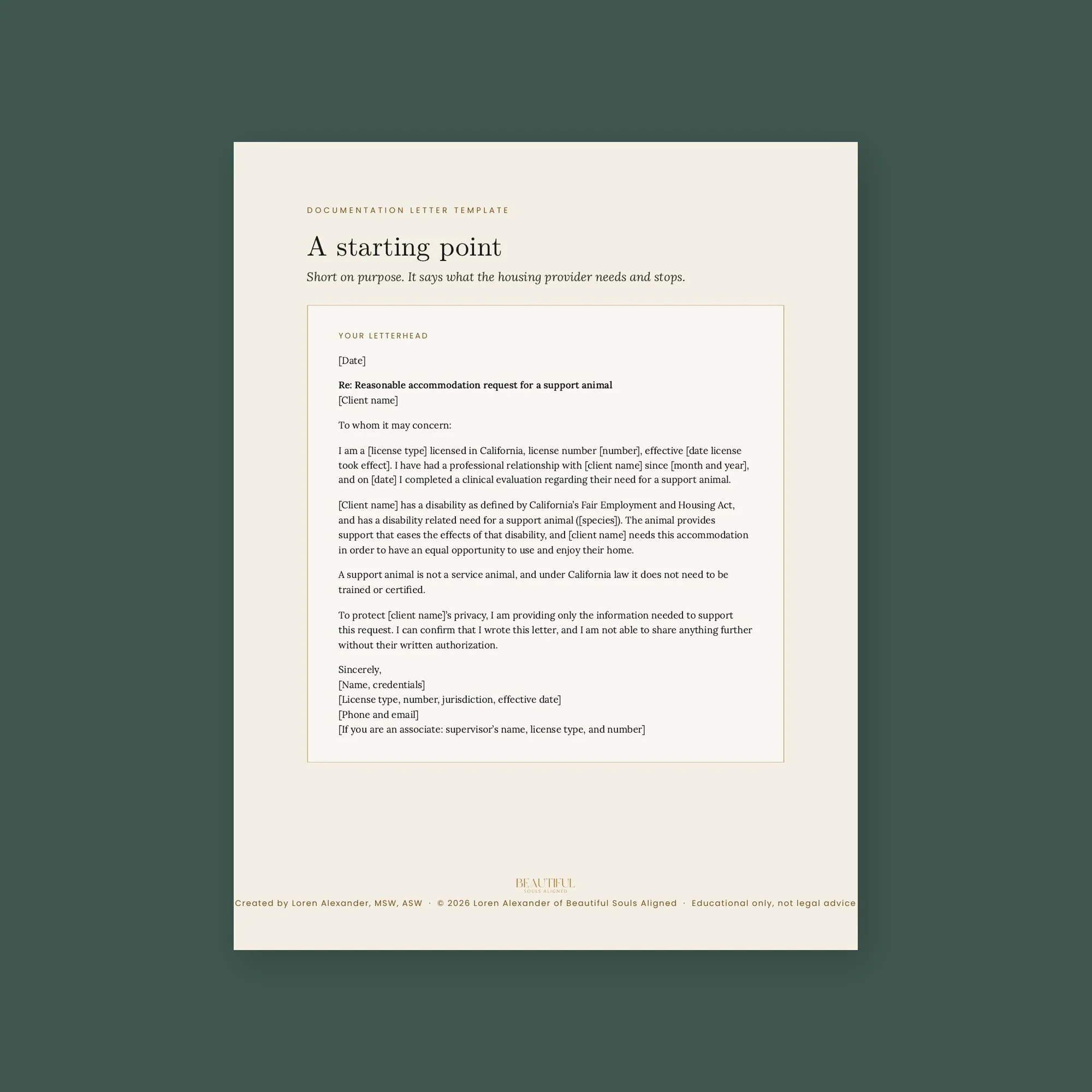
A free, professionally designed Emotional Support Animal (ESA) documentation template for licensed mental health professionals.
This resource is intended to provide a clear starting point for clinicians who prepare individualized ESA documentation as part of their professional practice. It includes an editable template that can be adapted to your own clinical judgment, documentation standards, and professional letterhead.
Included with this download:
• Editable Microsoft Word (.docx) template
• Printable PNG reference version
This template is provided as an educational resource and is not intended to replace clinical judgment, legal consultation, or professional responsibility. Every recommendation should be individualized based on the client's circumstances, applicable laws, and your licensing board's ethical standards.
Sources and Further Reading
This article provides general educational information and is not legal advice. Laws, licensing requirements, and professional standards vary by jurisdiction and may change. Clinicians should review current federal, state, and local requirements and consult their licensing board, supervisor, professional association, malpractice carrier, or qualified attorney regarding individual circumstances.
U.S. Department of Justice, ADA.gov, Service Animals
Explains that a service animal is a dog trained to perform work or a task directly related to a person’s disability. It also distinguishes trained psychiatric service animals from animals whose presence provides emotional support or comfort.
https://www.ada.gov/topics/service-animals/
U.S. Department of Justice, Frequently Asked Questions About Service Animals and the ADA
Provides more detailed guidance about psychiatric service animals, emotional support animals, training, certification, public access, housing, and the distinction between trained tasks and comfort provided by an animal’s presence.
https://www.ada.gov/resources/service-animals-faqs/
U.S. Department of Justice, ADA Requirements: Service Animals
Summarizes the federal ADA definition of a service animal and clarifies that animals whose sole function is comfort or emotional support are not service animals under the ADA. It also notes that housing law uses a broader assistance animal standard.
https://www.ada.gov/resources/service-animals-2010-requirements/
U.S. Department of Housing and Urban Development, Assistance Animals
Explains the Fair Housing Act framework for assistance animals. HUD defines an assistance animal as an animal that works, performs tasks, provides assistance, or provides emotional support that alleviates one or more identified effects of a disability. The page also explains reasonable accommodation requirements and the circumstances under which a housing provider may deny a specific request.
https://www.hud.gov/helping-americans/assistance-animals
California Assembly Bill 468, Emotional Support Animals
Establishes California requirements for health care practitioners providing documentation related to an individual’s need for an emotional support dog. Requirements include a valid professional license, authorization to practice in the relevant jurisdiction, a client and provider relationship of at least 30 days, a clinical evaluation, and notice regarding the difference between emotional support dogs and service dogs.
https://leginfo.legislature.ca.gov/faces/billTextClient.xhtml?bill_id=202120220AB468
California Business and Professions Code, Section 4996.9
Defines the practice of clinical social work. The statute includes counseling, psychotherapy, information and referral, arranging social services, interpreting psychosocial circumstances, and helping clients modify internal and external conditions affecting behavior, emotions, thinking, and functioning.
https://leginfo.legislature.ca.gov/faces/codes_displaySection.xhtml?lawCode=BPC§ionNum=4996.9
California Business and Professions Code, Section 4996.23
Describes the supervised experience required of Associate Clinical Social Workers. It includes clinical assessment and treatment, client centered advocacy, consultation, evaluation, research, supervision, and relevant training.
https://leginfo.legislature.ca.gov/faces/codes_displaySection.xhtml?lawCode=BPC§ionNum=4996.23
California Business and Professions Code, Sections 4996.23.1 through 4996.23.3
Addresses supervision requirements and the employment settings in which Associate Clinical Social Workers may provide mental health and related services. Associates must work as employees or volunteers, not independent contractors, and must perform services within settings authorized by their employer and supervision structure.
American Counseling Association, Emotional Support Animals Statement
The 2021 ACA statement referenced in the discussion advises counselors to understand applicable local, state, and federal laws and to possess appropriate competence regarding therapeutic human and animal interactions before providing ESA documentation.